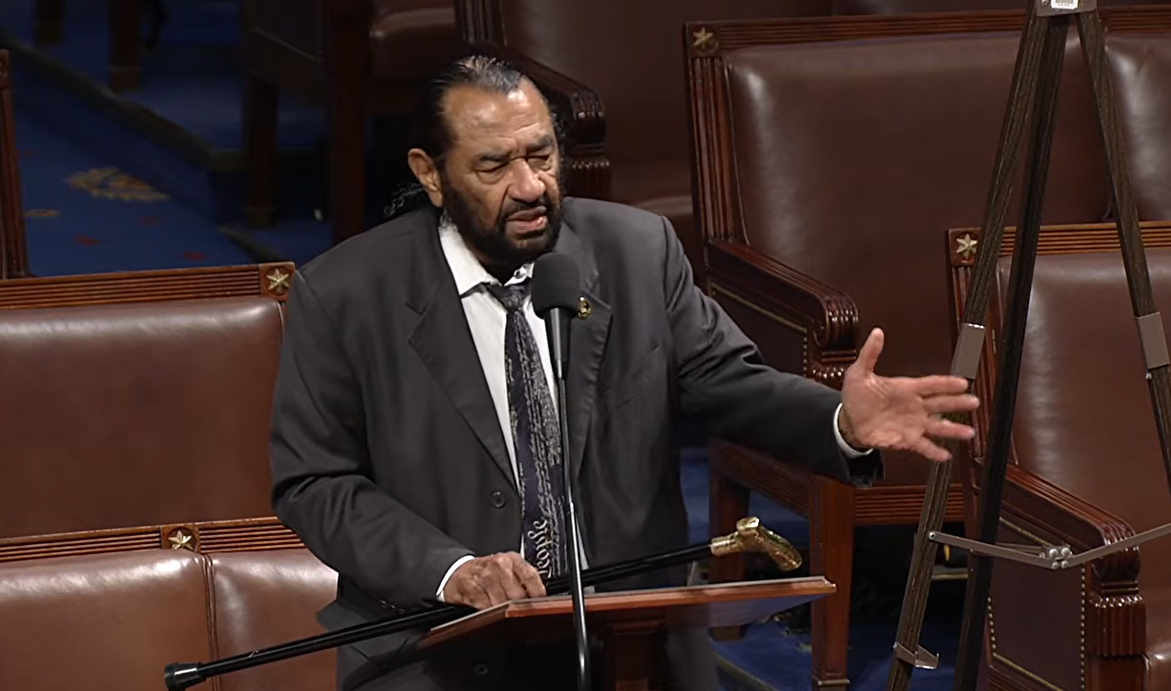
Congressman Al Green (D-TX) defended his actions on the House floor Wednesday, stating that his silent protest during President Donald Trump’s State of the Union address on Tuesday night was a deliberate stand against racist imagery and rhetoric.
Green said the genesis of his protest stemmed from Trump’s now-deleted Truth Social post sharing a video that depicted former President Barack Obama and former First Lady Michelle Obama as apes—imagery he called unacceptable and dehumanizing. Portraying people of African ancestry as less than fully human, he argued, echoes a painful history of racist caricature used to demean and marginalize Black Americans.
Determined to do more than issue a social media statement, Green said he chose to confront the issue directly. As the president entered the chamber, Green stepped into the aisle holding a sign that read, “BLACK PEOPLE AREN’T APES!” He described the gesture as a peaceful, silent protest intended to send a message. According to Green, he remained silent throughout and did not create a disturbance.

He contended that the disruption that followed was caused by colleagues—notably Senator Markwayne Mullin (R-OK), Representative Troy Nehls (R-TX), and House Majority Leader Steve Scalise (R-LA)—who reacted angrily, grabbing and tearing and attempting to confiscate his sign. Green said video footage would show that he did not instigate any disorder. Responding to talk of possible censure, he argued that if any discipline were warranted, it should be directed at those who turned a silent demonstration into a needless confrontation.
Green: ‘Black People Are Going To Move Forward With The Rest Of This Country’
Green noted that he has been censured before, after interrupting last year’s State of the Union address to object to proposed cuts to Medicaid, Medicare, and Social Security. On that occasion, he said, his protest was spontaneous. By contrast, he described his actions this time as planned, though undertaken only after consultation with his staff and personal reflection. Ultimately, he said, the decision was his alone.
Framing his protest as part of a broader struggle for dignity and equality, Green invoked the nation’s history of segregation and racial discrimination. He warned against what he characterized as a return to “ugly days” when Black Americans were relegated to second-class status and subjected to slurs and systemic exclusion.
Green reaffirmed that his demonstration was rooted in principle. He said he believes in speaking “truth to power” and would not be silenced. Black Americans, he declared, are not going backward but moving forward alongside the rest of the country.