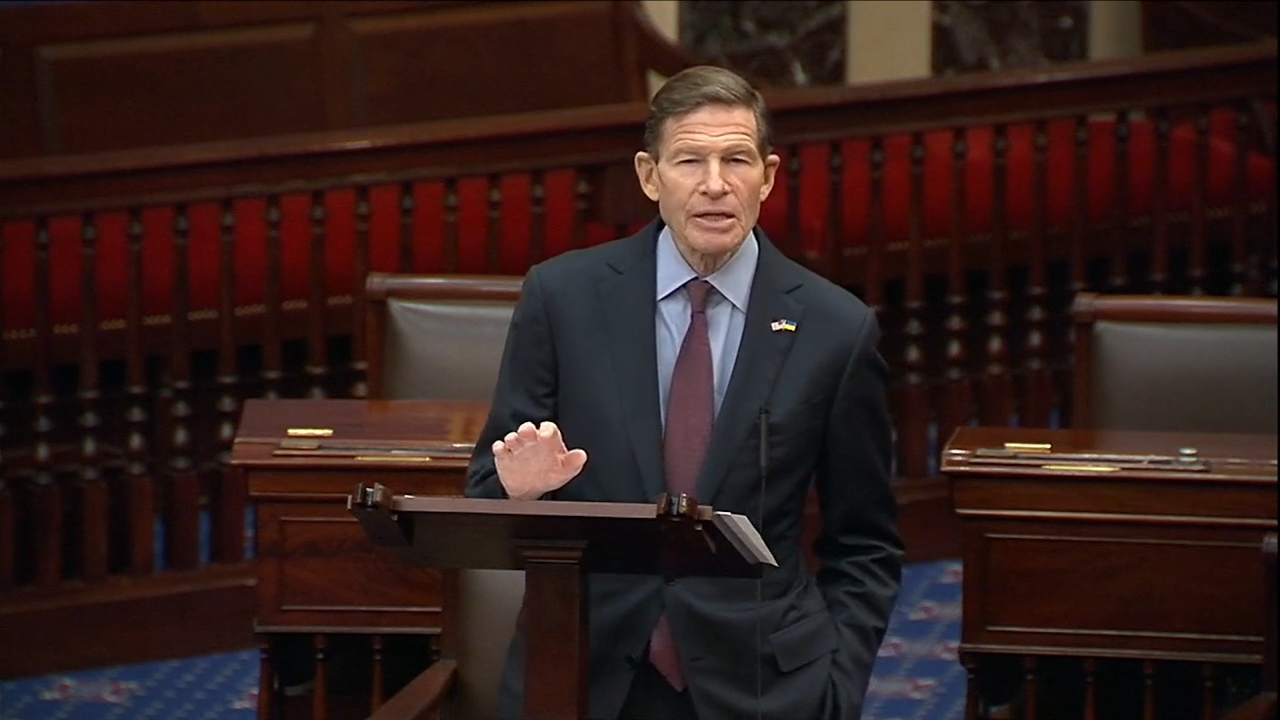
Senator Richard Blumenthal (D-CT) took to the Senate floor to mark the fourth anniversary of Vladimir Putin’s full-scale invasion of Ukraine, delivering a forceful defense of continued U.S. support and rejecting the false narrative that Russia is winning the war.
Blumenthal described Putin’s invasion as unprovoked, unjustified, and brutal—an attempt to extinguish Ukrainian democracy, erase its national identity, and redraw Europe’s borders by force. Four years later, he stated, those ambitions have failed. Ukraine, he said, remains scarred and bloodied but unbroken.
Fresh from his ninth trip to Ukraine, including visits to Kyiv and Odesa, Blumenthal recounted meetings with engineers restoring power facilities repeatedly targeted by Russian strikes, children abducted and later returned home, front-line forces defending the Black Sea, and the faith community. He also met with President Volodymyr Zelenskyy, whom he described as steadfast in his determination to push back Russian forces.
Blumenthal pushed back against claims that Russia’s incremental territorial gains signal momentum. Those advances, he said, have come at enormous human and material cost and do not amount to strategic victory. Ukraine has the will, the courage, and the resolve to prevail, he stated—what it needs are sustained weapons deliveries and stronger economic sanctions on Moscow.
“Peace is our devout hope,” he said in substance, but peace will come only through strength. In his view, Putin is not serious about negotiations and will respond only to unmistakable demonstrations of resolve.
Blumenthal also emphasized the broader stakes for the United States. Of the roughly 600 major American companies operating in Ukraine before the war, he said nearly half have been damaged or destroyed by Russian attacks. Putin, he pointed out, is not only bombing Ukrainian cities and civilians but harming American economic interests as well.
Blumenthal: ‘Ukraine Is Fighting Not Only For Itself, But For All Of Us’
Blumenthal described the conflict as the most destructive in Europe since World War II, with entire cities reduced to rubble, tens of thousands killed, and millions displaced. Families, he said, live nightly under the threat of drones and missiles. Yet he said the defining feature of his latest visit was the resilience of the Ukrainian people—resilience that, in his telling, demands more than symbolic support.
“They don’t want applause,” he said, stating that Ukraine wants weapons, not words.
Blumenthal called for tougher sanctions on Russia’s war economy, including shutting down what he described as the Kremlin’s “shadow fleet” used to transport oil and gas. He urged consideration of designating Russia a state sponsor of terrorism if abducted Ukrainian children are not returned and proposed using frozen Russian assets in Europe to finance additional arms for Kyiv, including advanced munitions and aircraft.
He framed support for Ukraine not as charity but as strategy, warning that Russia remains the most immediate threat to NATO and that appeasement would invite wider conflict. Democracies, he said, must prove Putin wrong in his belief that they will grow weary and fracture over time.
Four years into the war, Blumenthal concluded, Ukraine is fighting not only for its own sovereignty but for the principle that borders cannot be changed by force and that democracy cannot be extinguished by terror. The Senate, he stated, has shown bipartisan resolve before and must do so again.